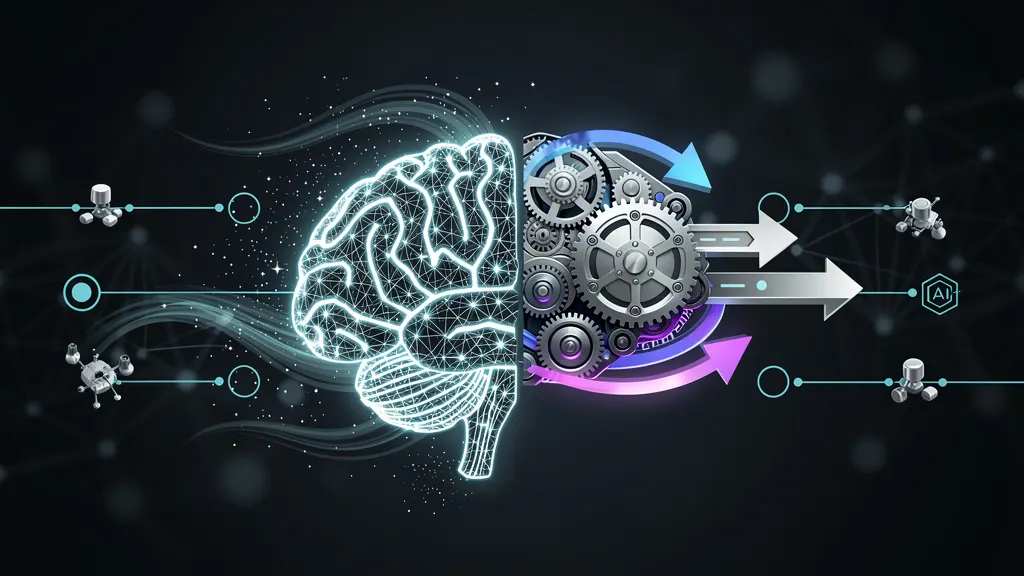
Agentic AI vs. Generative AI: Redefining Intelligent Systems
Generative AI creates content, while Agentic AI takes action. This article explores how combining these technologies enables autonomous agents to perceive, plan, and execute complex tasks.

Tags
Quick summary
Generative AI creates content, while Agentic AI takes action. This article explores how combining these technologies enables autonomous agents to perceive, plan, and execute complex tasks.
Agentic AI vs. Generative AI: Redefining Intelligent Systems
Artificial intelligence is evolving at a breathtaking pace, and two paradigms have emerged as the dominant forces shaping the future: Generative AI and Agentic AI. While both are rooted in deep learning and large language models, they serve fundamentally different purposes. Generative AI excels at creating content—text, images, code, and music—based on patterns learned from vast datasets. Agentic AI, on the other hand, is designed to act autonomously, making decisions, executing multi-step tasks, and interacting with environments to achieve specific goals.
This article provides a practical, technical comparison of these two approaches. We will explore their core differences, walk through a concrete installation and configuration of a popular generative AI model, and then demonstrate how to build a simple agentic system using open-source tools. By the end, you will have a clear understanding of when to use each paradigm and how to get started with both.
Understanding the Core Concepts
What is Generative AI?
Generative AI refers to models that learn the underlying distribution of training data and then generate new, similar data. The most prominent examples are large language models (LLMs) like GPT-4, Claude, and open-source alternatives like Llama and Mistral. These models are trained on massive text corpora and can produce coherent paragraphs, write code, translate languages, and even create images or audio when combined with other architectures (e.g., diffusion models for images).
The key characteristic of generative AI is its **output-centric nature**: it receives a prompt and returns a generated response. It does not inherently plan, reason about long-term consequences, or take actions in the world. It is a powerful tool for creation, summarization, and conversation, but it lacks autonomy.
What is Agentic AI?
Agentic AI, sometimes called "AI agents" or "autonomous agents," extends generative models with the ability to **perceive, reason, plan, and act**. An agentic system typically uses an LLM as its "brain" but wraps it with additional components: a memory system, a planning module, and a set of tools or APIs it can call. The agent can break down a complex goal into sub-tasks, execute them in order (e.g., search the web, run code, send an email), and adapt based on feedback.
Agentic AI is **action-oriented**. It does not just generate text; it performs tasks. Examples include autonomous coding assistants, research agents that browse the internet to answer questions, and robotic process automation (RPA) systems that interact with software interfaces.
Key Differences at a Glance
| Feature | Generative AI | Agentic AI | |------------------------|----------------------------------------|----------------------------------------------| | Primary function | Generate content (text, images, code) | Perform actions, achieve goals | | Autonomy | Low (requires prompts) | High (plans and executes multi-step tasks) | | Interaction pattern | Prompt → Response | Goal → Plan → Actions → Feedback → Adapt | | Tool use | Rarely (unless fine-tuned) | Core feature (APIs, web search, code exec) | | Memory | Usually limited to context window | Often includes persistent memory (vector DB) | | Example applications | Chatbots, content creation, translation| Research assistants, automation, game agents |
Requirements for This Tutorial
Before diving into the practical steps, ensure you have the following:
- A modern Linux, macOS, or Windows (WSL2) system with at least 8 GB RAM (16 GB recommended)
- Python 3.10 or later installed (`python --version`)
- A working internet connection
- An OpenAI API key (for generative AI example) or a local model (e.g., using Ollama)
- Basic familiarity with the command line and Python
Step-by-Step Installation: Setting Up a Generative AI Model
We will use **Ollama** to run a local generative AI model. This avoids API costs and gives us full control.
Step 1: Install Ollama
Ollama is a tool that simplifies running local LLMs. Install it with the following command.
curl -fsSL https://ollama.com/install.sh | shAfter installation, verify it works.
ollama --versionYou should see output like `0.3.12` or similar.
Step 2: Download a Generative AI Model
We'll use the `mistral` model, which is lightweight and performs well.
ollama pull mistralThis downloads the model (about 4.1 GB). Wait for completion.
Step 3: Test the Model via Command Line
Run a quick inference to confirm the model works.
ollama run mistral "Explain the difference between generative and agentic AI in one sentence."You should see a generated response. Exit the interactive session with `/bye`.
Step 4: Use the Model Programmatically
Install the Ollama Python library to integrate the model into your code.
pip install ollamaNow create a simple Python script (`gen_test.py`).
import ollama

response = ollama.chat(model='mistral', messages=[
    {'role': 'user', 'content': 'What is the capital of France?'}
])

print(response['message']['content'])
Run it.
python gen_test.pyExpected output: "The capital of France is Paris." This is pure generative AI: given a prompt, it returns a generated answer.
Building a Simple Agentic AI System
Now we will build a minimal agentic system using the same LLM as its core, but augmented with a planning loop and a tool (web search). We'll use the `smolagents` library from Hugging Face, which is designed for agents.
Step 1: Install Required Libraries
pip install smolagents duckduckgo-search`smolagents` provides the agent framework; `duckduckgo-search` gives us a free web search tool.
Step 2: Configure the Agent
Create a Python script (`agent.py`) with the following content.
from smolagents import CodeAgent, DuckDuckGoSearchTool, HfApiModel

# Initialize a model (you can use the same local model via Ollama, but for simplicity we use a HF endpoint)
model = HfApiModel()  # Requires internet and HF token, but you can replace with Ollama model

# Define the agent with a search tool
agent = CodeAgent(
    tools=[DuckDuckGoSearchTool()],
    model=model,
    max_steps=5,
    verbosity_level=2
)

# Run the agent on a task
agent.run("Find the latest news about Agentic AI and summarize it in three bullet points.")
Step 3: Run the Agent
Execute the script.
python agent.pyThe agent will: 1. Parse the goal: "Find the latest news about Agentic AI..." 2. Plan a search query. 3. Use the DuckDuckGo tool to fetch results. 4. Summarize the results using the LLM. 5. Return a final answer.
You should see logs showing each step: `[Step 1: Searching...]`, `[Step 2: Summarizing...]`, etc.
This is fundamentally different from generative AI—the agent **acts** (searches the web) and **adapts** its plan based on what it finds.
Usage Examples: Generative vs. Agentic in Practice
Generative AI Example: Content Creation
Use the local model to generate a blog outline.
ollama run mistral "Write a three-point outline for an article about AI agents."Output:
1. Introduction to AI agents and their capabilities
2. Key components: planning, memory, tools
3. Real-world applications and future directions
This is a one-shot generation—no iteration, no external action.
Agentic AI Example: Automated Research
Now let's use the agent to perform actual research.
Modify `agent.py` to run a research task.
agent.run("Research the latest advancements in generative AI from NVIDIA and summarize the key findings.")The agent will:
- Search the web for recent NVIDIA AI blog posts (source: developer.nvidia.com)
- Visit the pages (via search snippets)
- Compile a summary using the LLM
This is agentic because it involves multiple steps, tool use, and dynamic planning.
When to Use Each Paradigm
Choose Generative AI when:
- You need fast, high-quality content generation (chat, writing, code completion)
- The task is well-defined and does not require multi-step reasoning or external data
- You want a simple, stateless interaction (prompt → response)
Choose Agentic AI when:
- The task requires gathering information from multiple sources (web, databases, APIs)
- You need to execute a sequence of actions (e.g., "Book a flight, then send a confirmation email")
- The environment is dynamic, and the system must adapt to changing conditions
- You need persistent memory across sessions
Conclusion
Generative AI and Agentic AI represent two sides of the intelligent systems coin. Generative AI is a master craftsman, creating beautiful outputs from a single prompt. Agentic AI is an autonomous worker, planning, acting, and learning to achieve complex goals. The most powerful systems of the future will likely combine both: a generative model as the reasoning core, wrapped in an agentic framework that gives it arms and legs.
In this article, you learned the conceptual differences, installed and ran a local generative model (Mistral via Ollama), and built a simple agent using `smolagents`. You now have the practical foundation to explore both paradigms and decide which fits your next project. As NVIDIA, OpenAI, Microsoft, and Anthropic continue to innovate, the line between generative and agentic AI will blur, but understanding their distinct strengths today will give you a strategic advantage.
Sources
FAQ
What is this article about?
This article covers “Agentic AI vs. Generative AI: Redefining Intelligent Systems” in the AI agents category. Generative AI creates content, while Agentic AI takes action. This article explores how combining these technologies enables autonomous agents to perceive, plan, and execute complex tasks.
Who is this useful for?
It is useful for readers who want a practical understanding of AI tools, models, and workflows.
What should I do next?
Read the article, review the listed sources, and test the most relevant ideas in your own workflow.