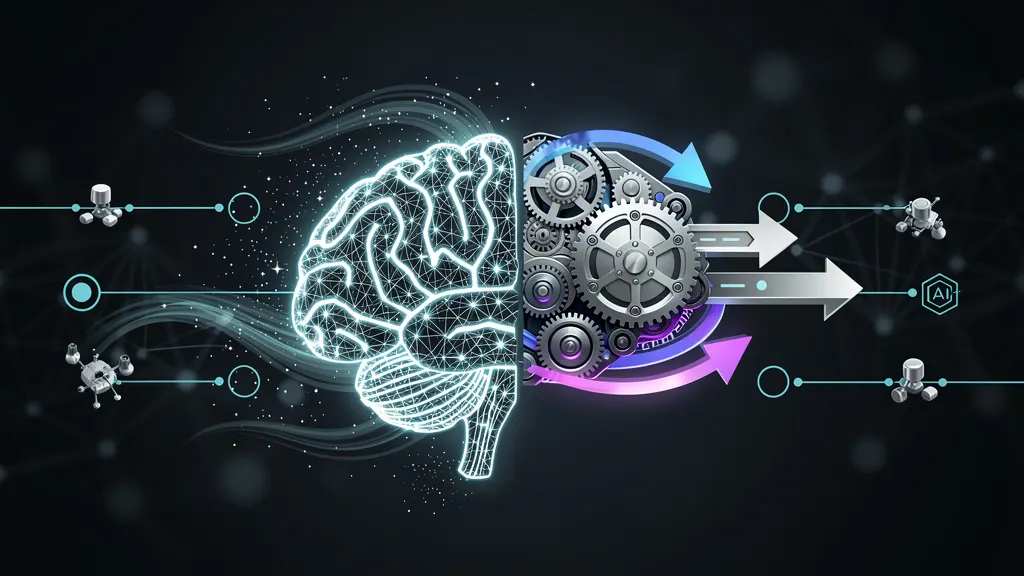
Agentic AI vs Generative AI: The Shift from Content Creation to Autonomous Action
Generative AI creates content; Agentic AI acts on it. This article explores how combining GPT models with autonomous agents enables dynamic decision-making, task execution, and real-world problem-solving.

Tags
Quick summary
Generative AI creates content; Agentic AI acts on it. This article explores how combining GPT models with autonomous agents enables dynamic decision-making, task execution, and real-world problem-solving.
Agentic AI vs Generative AI: The Shift from Content Creation to Autonomous Action
The artificial intelligence landscape is undergoing a profound transformation. For the past few years, the spotlight has been on generative AI—models that create text, images, code, and music with astonishing fluency. But a new paradigm is emerging: agentic AI. While generative AI excels at producing content on demand, agentic AI builds on that foundation to take autonomous, goal-directed action. This article explores the differences, the technical underpinnings, and how developers can start building agentic systems today.
What is Generative AI?
Generative AI refers to models that generate new data similar to their training data. These include large language models (LLMs) like GPT-4, image generators like DALL-E, and code assistants like GitHub Copilot. The core capability is **content creation**: given a prompt, the model produces a coherent output—be it a paragraph, an image, or a function.
Generative AI is reactive. It waits for a user input, processes it, and returns a result. It does not initiate actions, set goals, or operate over long time horizons. Its strength lies in its ability to mimic human creativity and knowledge.
What is Agentic AI?
Agentic AI extends generative AI by adding autonomy, goal-setting, and multi-step reasoning. An agentic system can:
- Perceive its environment (via APIs, sensors, or text inputs)
- Formulate plans to achieve a user-defined goal
- Execute actions (calling APIs, writing files, sending emails)
- Monitor outcomes and adjust its behavior
- Operate over extended periods without human intervention
In short, agentic AI moves from **"create this for me"** to **"achieve this for me."** This shift is being driven by research and products from organizations like OpenAI, Microsoft, and Anthropic, as well as open-source frameworks.
Key Differences: Generative vs Agentic
| Aspect | Generative AI | Agentic AI | |--------|---------------|------------| | Primary Function | Content creation | Autonomous action | | Interaction Model | Single-turn prompt/response | Multi-step, goal-oriented | | Statefulness | Stateless (per request) | Maintains state across steps | | Tool Use | None or limited | API calls, file I/O, web search | | Planning | None | Decomposes goals into sub-tasks | | Error Recovery | None | Retries, fallbacks, self-correction |
How Agentic AI Works
At its core, an agentic system uses a generative model as its "brain" but wraps it with a **planning loop**, a **tool execution engine**, and a **memory system**. The typical architecture:
1. **User provides a high-level goal** (e.g., "Research the latest AI trends and email me a summary"). 2. **The agent plans**: The LLM decomposes the goal into steps (e.g., search web, read articles, summarize, send email). 3. **The agent executes**: It calls tools (web search, file writer, email API) step by step. 4. **The agent observes and adapts**: It checks results, handles errors, and re-plans if needed. 5. **The agent completes**: It returns the final outcome or continues monitoring.
Frameworks like LangChain, AutoGPT, and Microsoft's Semantic Kernel provide the scaffolding for building such systems.
Practical Implementation: Building a Simple Agent
Let's build a minimal agentic system using Python and LangChain. This agent will take a natural language goal, use a search tool, and generate a report.
Requirements
- Python 3.10 or later
- An OpenAI API key (or another LLM provider)
- A search API key (e.g., SerpAPI or Tavily)
- Basic familiarity with the command line
Step-by-step Installation
**Step 1: Create a virtual environment and install dependencies.**
python -m venv agent-env
source agent-env/bin/activate  # On Windows: agent-env\Scripts\activate
**Step 2: Install the required packages.**
pip install langchain langchain-openai langchain-community python-dotenv**Step 3: Set up environment variables.**
Create a `.env` file in your project directory:
OPENAI_API_KEY=your-openai-api-key-here
TAVILY_API_KEY=your-tavily-api-key-here
**Step 4: Write the agent script.**
Create a file named `simple_agent.py` with the following code:
import os
from dotenv import load_dotenv
from langchain_openai import ChatOpenAI
from langchain.agents import create_react_agent, AgentExecutor
from langchain.tools import Tool
from langchain_community.tools import TavilySearchResults
from langchain import hub

# Load environment variables
load_dotenv()

# Initialize the LLM
llm = ChatOpenAI(model="gpt-4", temperature=0)

# Initialize the search tool
search_tool = TavilySearchResults(max_results=3)

# Define a custom tool for summarization
def summarize_text(text: str) -> str:
    """Summarize a given text."""
    response = llm.invoke(f"Summarize this text in 3 bullet points:\n{text}")
    return response.content

summary_tool = Tool(
    name="TextSummarizer",
    func=summarize_text,
    description="Useful for summarizing long texts. Input should be the text to summarize."
)

# Create the agent
tools = [search_tool, summary_tool]
prompt = hub.pull("hwchase17/react")
agent = create_react_agent(llm, tools, prompt)
agent_executor = AgentExecutor(agent=agent, tools=tools, verbose=True, handle_parsing_errors=True)

# Run the agent
goal = "Find the latest news about agentic AI and write a short summary of the top article."
result = agent_executor.invoke({"input": goal})
print("\n--- Final Output ---")
print(result["output"])
**Step 5: Run the agent.**
python simple_agent.pyExplanation of the Code
- `TavilySearchResults`: A real-time web search tool. The agent calls it to gather information.
- `TextSummarizer`: A custom tool that uses the LLM to condense content.
- `create_react_agent`: Builds an agent that uses the ReAct (Reasoning + Acting) pattern. The agent thinks, acts, observes, and repeats.
- `AgentExecutor`: Runs the loop, handling tool calls and error recovery.
Usage Examples
Example 1: Research and Report
Goal: "Research the impact of generative AI on education and write a report saved to a file."
from langchain.tools import Tool

def write_file(filename: str, content: str) -> str:
    """Write content to a file."""
    with open(filename, 'w') as f:
        f.write(content)
    return f"File {filename} written successfully."

file_tool = Tool(
    name="FileWriter",
    func=write_file,
    description="Writes text to a file. Input should be 'filename|content'."
)

# Add file_tool to the tools list and rerun
Example 2: Automated Email Summarizer
Goal: "Read the latest emails from my inbox (simulated) and summarize the top 3."
You would add an email tool (e.g., using Gmail API) and let the agent iterate over messages.
Example 3: Multi-step Data Pipeline
Goal: "Fetch the latest stock prices for AAPL, GOOGL, and MSFT, calculate the average, and plot a chart."
The agent would call a financial data API, perform calculations, and use a plotting library.
The Shift: From Passive to Proactive
Generative AI is like a brilliant assistant who only speaks when spoken to. Agentic AI is like a proactive employee who understands your goals, plans the work, executes it, and reports back. This shift has profound implications:
- **Productivity**: Agents can handle complex, multi-hour tasks without supervision.
- **Integration**: Agents connect to existing systems (CRMs, databases, APIs) to act on real-world data.
- **Scalability**: A single agent can manage dozens of parallel workflows.
Microsoft's AI blog emphasizes that agents are becoming "a new class of applications that can reason, plan, and act on behalf of users." Similarly, Anthropic's research into constitutional AI and tool use points toward safer, more capable agents.
Challenges and Considerations
Agentic AI is not without risks:
- **Reliability**: Agents can hallucinate or make incorrect tool calls. Robust error handling and human oversight are critical.
- **Security**: Agents with access to sensitive APIs or files must be sandboxed and permission-limited.
- **Cost**: Each agent step consumes tokens and API calls. Long-running tasks can be expensive.
- **Alignment**: Ensuring the agent's actions match user intent requires careful prompt engineering and testing.
The Future: Generative + Agentic
The two paradigms are not mutually exclusive. The most powerful systems will blend generative and agentic capabilities. For example:
- A generative model creates a draft email.
- An agentic system sends it, monitors replies, and schedules follow-ups.
- Another agentic system researches the recipient's company and updates the email content accordingly.
NVIDIA's AI blog highlights how generative models are being embedded into autonomous systems for robotics and simulation. OpenAI's news section discusses "agents that can browse the web, use apps, and perform tasks on your behalf."
Conclusion
The shift from generative AI to agentic AI represents a maturation of the field. Generative AI gave us the ability to create; agentic AI gives us the ability to act. By combining the reasoning power of LLMs with tool use, planning, and memory, developers can build systems that don't just answer questions but solve problems.
Whether you are building a personal research assistant, an automated customer support bot, or a data pipeline manager, the principles are the same: define a goal, equip the agent with tools, and let it iterate. The code examples above provide a starting point. As frameworks improve and costs decrease, agentic AI will become as commonplace as generative AI is today.
The next wave of innovation will not be about what AI can create, but what it can accomplish.
Sources
FAQ
What is this article about?
This article covers “Agentic AI vs Generative AI: The Shift from Content Creation to Autonomous Action” in the AI agents category. Generative AI creates content; Agentic AI acts on it. This article explores how combining GPT models with autonomous agents enables dynamic decision-making, task execution, and real-world problem-solving.
Who is this useful for?
It is useful for readers who want a practical understanding of AI tools, models, and workflows.
What should I do next?
Read the article, review the listed sources, and test the most relevant ideas in your own workflow.