Ask a Scientist: How Researchers Use AI to Help Pregnant Women Access Ultrasounds
In this Ask a Scientist explainer, researchers describe how AI can make ultrasound access more equitable for pregnant women. The work focuses on image acquisition and interpretation where trained sonographers are scarce, while noting validation and deployment limits. The source is a Google Research blog post dated October 6, 2026.
Tags
Quick summary
In this Ask a Scientist explainer, researchers describe how AI can make ultrasound access more equitable for pregnant women. The work focuses on image acquisition and interpretation where trained sonographers are scarce, while noting validation and deployment limits. The source is a Google Research blog post dated October 6, 2026.
Ask a Scientist: How Researchers Use AI to Help Pregnant Women Access Ultrasounds
Prenatal ultrasound is one of the most information-dense tools in medicine. It can estimate how far along a pregnancy is, reveal whether a fetus is growing as expected, and flag conditions that change the course of care. The problem is that the value of an ultrasound is not evenly distributed. It depends on having a machine, a trained operator, a stable power supply, and a health system capable of acting on whatever the image shows. Remove any one of those, and the image either never happens or never helps.
That is the gap the Google AI Blog entry "Ask a Scientist: How are researchers using AI to help pregnant women access ultrasounds?" is concerned with. The post, published on October 6, 2026, sits in a series where researchers answer a single question in plain language. Its URL points to a specific technique — blind sweep ultrasound — which tells us something about the research direction even before we get into detail.
This article explains the problem, describes what a blind sweep approach conceptually involves, and is explicit about where verified information ends and reasonable interpretation begins. That distinction matters here, because the honest version of this story includes a long list of things that are still unproven.
The Access Gap That Motivates the Work
Ultrasound is not a single test. It is a family of exams, and the most common prenatal ones are operator-dependent. A sonographer places a probe on the abdomen at specific angles to capture standard views: the head, the femur, the abdominal circumference, sometimes the heart. From those views, measurements are taken and compared against growth curves. The clinical conclusion depends on getting the right views in the first place.
That requirement has consequences. Producing a competent sonographer takes years. Ultrasound machines are expensive to buy and maintain. In many settings, the nearest trained operator may be hours away, and the nearest specialist who can interpret a complicated finding may be further still. The result is a familiar pattern in global health: a technology that is routine in high-resource cities becomes sporadic or absent in rural clinics, even when the clinical need is greater.
There is a second, subtler problem. Even when an ultrasound happens, the interpretation may lag. A scan performed by a visiting technician might be reviewed days later. For decisions that are time-sensitive — dating a pregnancy accurately, identifying a growth restriction, deciding whether to refer — a delay changes the value of the information.
Both of these problems are, in principle, addressable with software. That is what makes the space attractive to AI researchers.
What the Source Actually Establishes
Before going further, it is worth being precise about the evidence base for this article. The verified facts are narrow. There is a Google AI Blog post titled "Ask a Scientist: How are researchers using AI to help pregnant women access ultrasounds?", it carries a publication timestamp of October 6, 2026, and it lives at a URL whose slug reads blind-sweep-ultrasounds-ai.
Everything beyond that — the mechanics of blind sweep acquisition, the architecture of any model, the performance of any system, the clinical partners involved — is interpretation. The post is an accessible primary source and an entry point to a research direction; it is not a specifications sheet. Where this article describes how such a system would plausibly work, it does so as conceptual explanation, not as a claim about a specific published result.
That is not a weakness of the article. It is the correct posture when a source is a research-communication piece rather than a technical paper.
What "Blind Sweep" Means
The phrase in the URL is the most technically informative thing the source gives us, so it is worth unpacking carefully.
Standard obstetric ultrasound is a targeted acquisition. The operator knows what plane they need, moves the probe to find it, and confirms the view on the screen before capturing. Skill and image interpretation are fused in the same person at the same moment. If the operator cannot recognize the correct plane, the exam fails quietly — the image looks like an ultrasound, but it does not carry the measurement the clinician needs.
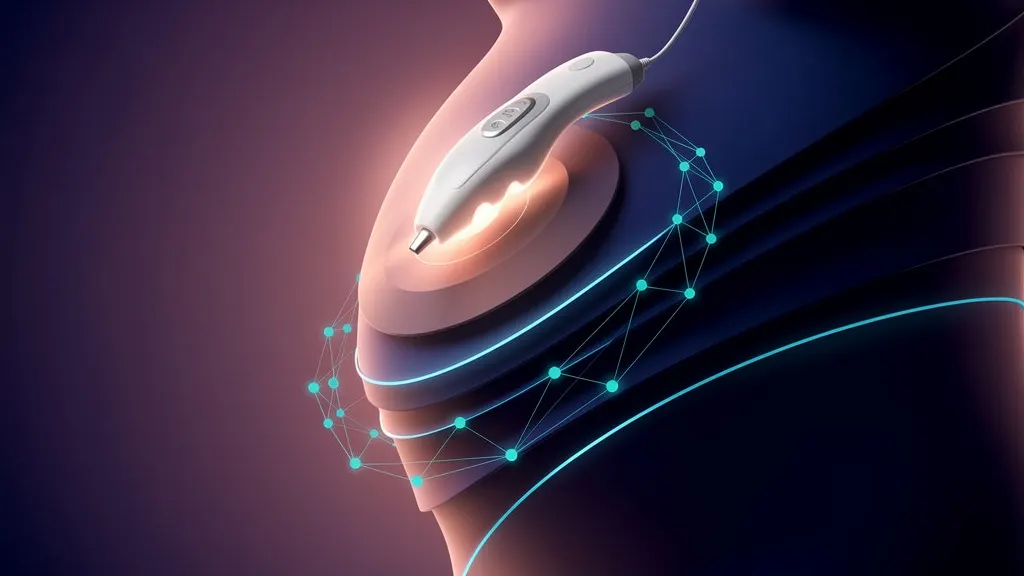
A blind sweep inverts that arrangement. Rather than asking the operator to hunt for a specific view, it asks them to sweep the probe across the abdomen in a systematic pass, recording a continuous stream of frames. The operator does not need to identify anatomy, does not need to freeze the right moment, and does not need to distinguish a good view from a poor one. The burden of finding clinical signal shifts from the person holding the probe to the model processing the video.
This is a meaningful division of labor. It means the skill required at the point of care drops from "recognize fetal anatomy in real time" to something closer to "place the probe correctly and complete the sweep." Those are very different training requirements.
"Blind" Does Not Mean Uncontrolled
The word "blind" invites a misunderstanding: that the operator waves the probe around and the AI somehow extracts meaning from noise. That is not the idea. Blind here refers to blindness to anatomical landmarks, not to the absence of protocol.
A workable sweep is still a deliberate motion. It has a starting point, a path, and a duration. It is designed so that the anatomy of interest passes through the field of view at some point, even though no one at the bedside knows exactly when. The intelligence lives downstream, in software that can look across hundreds or thousands of frames and decide which ones contain usable information.
The analogy is imperfect but useful: a blind sweep is less like taking a photograph and more like recording a short film of the abdomen and letting a model decide which frames matter. The operator supplies coverage; the model supplies selection.
The Pipeline, Conceptually
Describing the architecture of any particular system would go beyond what the source supports. What can be described is the general shape of the problem, which any system in this category has to solve.
Acquisition. A probe connected to a device — potentially a low-cost handheld unit rather than a full cart-based machine — records video during a guided sweep.
Frame triage. Most frames in a sweep are uninformative. A model must identify the subset that contains the structures relevant to the clinical question, discarding frames where the anatomy is absent, obscured, or at an unusable angle.
Temporal reasoning. Because the sweep passes through anatomy progressively, information is distributed across time. How consecutive frames relate to one another matters. This is a video-understanding problem, not a still-image classification problem.
Task-specific inference. Depending on the goal, the model may estimate gestational age from biometric measurements, classify whether a required view was captured, or flag a potential abnormality for review.
Uncertainty and escalation. A system that only outputs a confident answer is dangerous. The clinically useful output is often "this sweep is adequate" or "this sweep is inconclusive, refer the patient" — a decision about the data quality itself.
Each of these stages has its own failure modes, and they compound. A frame triage error upstream corrupts everything downstream.
An Illustrative Workflow
To make this concrete, consider a hypothetical — and explicitly hypothetical — clinic scenario. A midwife at a rural health post has a handheld ultrasound device and a tablet. A pregnant woman arrives for a first antenatal visit. The midwife performs a sweep lasting under a minute, watching only to ensure the probe stays in contact and the path is followed. The recording syncs to the tablet.
On-device software processes the video and returns an estimated gestational age with a confidence indicator, plus a note that the sweep quality was adequate. The midwife records the estimate in the patient's chart and, in the same visit, schedules follow-up aligned to that date. If the software had returned a low-confidence result, the protocol would be referral rather than a guess.
The value in this scenario is not that the software diagnosed anything rare. It is that a dating estimate that would otherwise have been unavailable — or available only after a long trip to a district hospital — became available in twenty minutes, at the point of care, in a form the midwife could act on.
That framing is also a constraint. The system is useful only if the output is something the local workflow can consume, and only if acting on it is possible.
The Human Factors Are Not Peripheral
It is tempting to treat a project like this as a pure machine-learning problem. It is not. Three human questions determine whether it works at all.
Who holds the probe? If the answer is "a trained sonographer," the access problem is unchanged. The premise only holds if the operator can be a nurse, midwife, or community health worker with limited imaging training.
What is the training burden? A sweep still has to be performed correctly enough for the anatomy to enter the field of view. The training may be shorter and more procedural than sonography training, but it is not zero, and it has to be deliverable at scale.
What happens after the output? An estimate of gestational age is only useful if it changes a decision — scheduling, referral, supplementation, delivery planning. A screening flag is only useful if there is a referral pathway. Software that produces accurate numbers into a system with no capacity to respond has not solved the access problem; it has moved it.
Validation Is the Hard Part
For any AI system in medicine, the technical demonstration is the easy chapter. The difficult chapter is showing that the system works across the conditions it will actually encounter.
Several sources of variation are predictable here. Devices differ in image quality and probe characteristics. Operators differ in how they sweep. Patients differ in body habitus, which changes how easily structures are visualized. Populations differ in the distribution of gestational ages and conditions. A model tuned on data from one hospital may degrade quietly in another setting — and quiet degradation is the worst kind, because the output still looks like a number.
This is why a project of this kind generally needs prospective evaluation in the target setting, not just retrospective accuracy on a held-out dataset. It also needs a clear regulatory path, because software that informs obstetric decisions is a medical device question, not a research demo question.
None of these are objections to the research. They are the standard hurdles, and they are why the field moves more slowly than the excitement around it.
What This Research Is Not
It is worth stating plainly, because headlines tend to collapse these distinctions:
- It is not a replacement for sonographers. Skilled imaging remains the standard for detailed anatomical assessment.
- It is not a diagnostic system for fetal anomalies unless and until it is validated as one. Estimating gestational age and detecting anomalies are different tasks with different risk profiles.
- It is not a substitute for access to care. The cheapest, most accurate dating estimate in the world does not help a patient who cannot reach a facility when the pregnancy becomes complicated.
- It is not a solved problem. The gap between a promising research direction and a deployed public-health tool is measured in years.
Open Questions the Evidence Does Not Answer
Given that the source is a research-communication post, a number of questions remain genuinely open:
- Which clinical tasks the system is designed to perform, and in what order of priority.
- How much operator training the sweep protocol requires in practice.
- What hardware assumptions the approach makes.
- How performance holds up across devices, populations, and body habitus.
- How the system communicates uncertainty, and what the escalation protocol looks like.
- What regulatory and clinical validation steps have been completed.
These are not gaps in the reporting so much as the natural frontier of an active research area.
Conclusion
The appeal of using AI to widen access to prenatal ultrasound is structural, not incidental. Ultrasound produces rich information but demands scarce expertise at the point of acquisition. A blind sweep approach attacks that specific bottleneck: it moves the expertise from the bedside to the model, allowing a simpler, more widely deliverable action at the point of care. Whether that shift produces a clinically reliable system — across devices, operators, and populations — is the question the research has to answer, and it is a question that cannot be settled by a demonstration alone. The source post is best read as a window into a research direction rather than a verdict on it, and the honest reading keeps the optimism and the open limits side by side.
Source: Ask a Scientist: How are researchers using AI to help pregnant women access ultrasounds? — Google AI Blog — https://blog.google/innovation-and-ai/models-and-research/google-research/blind-sweep-ultrasounds-ai