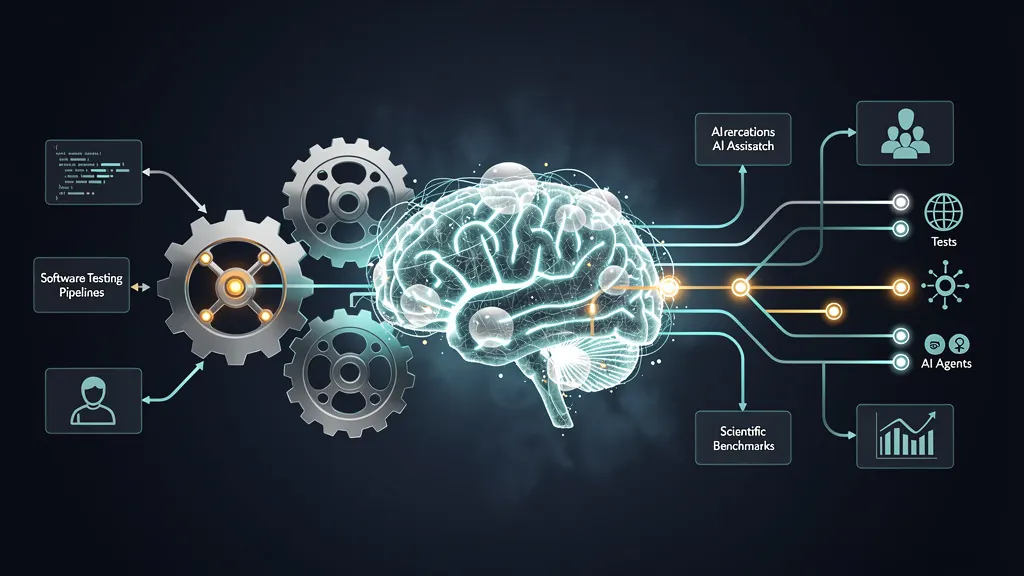
Agentic AI vs. Generative AI: Bridging Creation and Action
Generative AI creates content, while agentic AI takes action. Together, they form intelligent systems that can perceive, reason, and execute tasks autonomously. This article explores the synergy between these technologies, real-world applications, and how combining generative models with agent architectures is reshaping automation, decision-making, and human-AI collaboration.

Tags
Quick summary
Generative AI creates content, while agentic AI takes action. Together, they form intelligent systems that can perceive, reason, and execute tasks autonomously. This article explores the synergy between these technologies, real-world applications, and how combining generative models with agent architectures is reshaping automation, decision-making, and human-AI collaboration.
Agentic AI vs. Generative AI: Bridging Creation and Action
The past two years have transformed artificial intelligence from a curiosity into a daily productivity tool. If you follow the official news channels of the major AI providers—OpenAI, Microsoft, NVIDIA, and Anthropic—you will notice a clear pattern. The conversation has moved from "what can a model generate?" to "what can a model actually accomplish?" That shift is the difference between generative AI and agentic AI. One creates. The other acts. Understanding both is important, but bridging them is where the real value lives.
The State of AI: From Chatbots to Digital Workers
Generative AI became mainstream with the arrival of large language models that could write essays, generate code, and produce stunning images. OpenAI's news pages, Microsoft's AI blog, and Anthropic's updates all reflect this wave. The initial promise was simple: type a prompt, get a high-quality output.
But a prompt, by itself, does not complete a task. Writing a draft of a report is not the same thing as producing a finished report, saving it to the right folder, sending it to the right people, and updating a project tracker. That is why the industry has moved toward agentic AI. NVIDIA's developer blog, for instance, has spent considerable time explaining how generative models are being turned into autonomous systems that interact with tools, APIs, and environments.
Agentic AI is not a replacement for generative AI. It is the next layer. If generative AI is the brain that thinks, agentic AI is the body that acts. This article explores the difference, shows you why both matter, and provides a practical path to building your first agentic system.
What Is Generative AI?
Generative AI refers to models that create new content. Given a prompt, a generative model produces text, code, audio, images, or video. The defining feature is that the model has learned patterns from training data and can generate statistically plausible continuations.
Examples include:
- Writing an email from a few bullet points
- Drafting Python code from a comment
- Generating a marketing image from a text description
- Summarizing a long document
Generative models are typically **stateless**. They receive input, produce output, and forget the interaction unless you manually keep a conversation history. The output is the product. You take it, you review it, and you decide what happens next.
In practical terms, generative AI is an incredible **assistant**. It can make you faster by producing high-quality drafts. But it cannot, on its own, close the loop. It cannot check whether its output is correct, integrate with external systems, or recover from unexpected errors.
What Is Agentic AI?
Agentic AI builds on generative AI, but it shifts the focus from producing an output to completing an objective. An agent is a system that can plan, reason, use tools, and execute multi-step workflows. The generative model still plays a central role—it serves as the agent's reasoning engine—but the output is no longer the final product. The completed goal is.
Consider the difference:
- **Generative AI** writes a summary of today's market news.
- **Agentic AI** reads today's market news, writes a summary, scans a financial database, updates a dashboard, and sends you a notification with a link to the results.
An agent decides what needs to happen, in what order, and with which tools. If the first approach fails, the agent can try a different one. If a tool returns unexpected data, the agent can adjust its plan. This is what engineers call a **closed loop**.
Microsoft's AI blog has highlighted this framing repeatedly: agents are not just models but "systems of action." They combine a model with memory, tools, and an execution loop. Anthropic's news has similarly discussed "tool use" as a core capability, where models learn when and how to call external functions.
The Key Differences at a Glance
| Aspect | Generative AI | Agentic AI | |---|---|---| | Primary output | Content (text, code, image) | Completed task | | State | Stateless per call | Maintains memory and context | | Flow | Single prompt → response | Multi-step plan → execute → verify | | Tools | Optional, usually manual | Essential, automatic | | Error handling | None by itself | Can retry and adapt | | Example use | Write a blog post draft | Publish the post and share it |
The table is simplified, but it captures the core distinction. Generative AI is about **creation**. Agentic AI is about **action**, made possible through creation.
Why the Distinction Matters in Real Work
Think about a typical software developer's workflow. A generative model can write a function that validates email addresses. That is helpful. But a true agent could:
1. Read the codebase to understand the existing validation logic 2. Identify inconsistencies across modules 3. Write the new validation function 4. Run the existing test suite 5. Fix any failing tests 6. Create a pull request 7. Tag a reviewer
Each step involves generation, but the overall system is agentic. The value is not in the individual snippet of code. The value is in the fact that a multi-step process ran without a human at every step.
This is why enterprises are so interested in agentic systems. According to the ongoing coverage on NVIDIA's developer blog, tools like Retrieval-Augmented Generation (RAG) and function calling are paving the way for agents that can ground themselves in real data and take real actions. The practical consequence is that AI moves from a suggestion engine to an execution engine.
Requirements
Before we start, here is what you will need for the practical part of this article.
- **Python 3.10 or newer**: Most modern AI frameworks require recent Python versions.
- **pip**: Python's package manager, included with most Python installations.
- **An API key**: For example, an OpenAI API key or an Anthropic API key. Many frameworks default to OpenAI-compatible endpoints.
- **A terminal**: macOS Terminal, Windows PowerShell, or any Linux shell.
- **Internet access**: To install packages and call remote models.
Optionally, a code editor like VS Code makes it easier to edit the scripts we will create.
Step-by-step installation
Let me walk you through installing the tools needed to build both a generative application and a small agentic crew.
Step 1: Create a virtual environment
A virtual environment keeps your project dependencies isolated from the rest of your system. In your terminal, run:
python3 -m venv ai-envThis creates a folder named `ai-env` containing an isolated Python installation. Next, activate it:
source ai-env/bin/activateOn Windows, the activation command is slightly different:
ai-env\Scripts\activateStep 2: Upgrade pip
Upgrade pip first to ensure you get the latest package versions:
pip install --upgrade pipStep 3: Install the core packages
We will install two libraries. The `openai` package lets us make direct calls to generative models. The `crewai` package lets us orchestrate multiple agents that work toward a common goal.
pip install openai crewaiThis command downloads the libraries and their dependencies. Depending on your network speed, it may take a minute or two.
Step 4: Set your API key
Most agentic frameworks need an API key to call the underlying model. Export it as an environment variable:
export OPENAI_API_KEY="your-api-key-here"If you use Anthropic models instead, you would export `ANTHROPIC_API_KEY`. For this tutorial, we will stick with OpenAI. Make sure you replace `your-api-key-here` with a real key from the OpenAI platform.
Step 5: Verify the installation
Now, run a quick check to confirm everything is installed correctly:
python -c "import openai, crewai; print('All packages installed successfully.')"If you see the success message, you are ready to go.
Usage examples
Let's build two small programs to see the difference between generative and agentic approaches in action.
Example 1: A pure generative AI call
This script uses the OpenAI SDK directly. It sends a single prompt and prints the response. Nothing more.
from openai import OpenAI

client = OpenAI(api_key="YOUR_API_KEY")

response = client.chat.completions.create(
    model="gpt-4o-mini",
    messages=[
        {
            "role": "system",
            "content": "You are a concise technical writer."
        },
        {
            "role": "user",
            "content": "Explain the difference between generative and agentic AI in three sentences."
        }
    ]
)

print(response.choices[0].message.content)
Before running this script, save it as `generative_example.py`. In your terminal, execute:
python generative_example.pyYou will see a short AI-generated explanation. It is useful, but it is a single interaction. The AI does not research anything, verify anything, or take any further action. The creation and the responsibility for next steps are entirely on you.
Example 2: A small agentic crew
Now let's build something more ambitious. We will define two agents. One researches recent AI topics from the official news pages of the major providers. The other takes that research and writes a memo to a markdown file.
Save the following code as `agentic_example.py`:
from crewai import Agent, Task, Crew, Process

researcher = Agent(
    role="AI Research Analyst",
    goal="Identify recent AI trends from major AI provider news pages.",
    backstory=(
        "You are an experienced analyst who monitors OpenAI News, "
        "the Microsoft AI Blog, the NVIDIA AI Blog, and Anthropic News. "
        "You summarize trends without inventing details."
    ),
    verbose=True
)

writer = Agent(
    role="Technical Memo Writer",
    goal="Turn research notes into a concise memo and save it to a file.",
    backstory=(
        "You are a technical writer who creates clean, actionable memos. "
        "You save all output as markdown files."
    ),
    verbose=True
)

research_task = Task(
    description=(
        "Review the latest topics discussed on the OpenAI, Microsoft, "
        "NVIDIA, and Anthropic news pages. Report the general themes "
        "you observe. Do not make up specific claims or statistics."
    ),
    expected_output="A bullet-point list of observed themes.",
    agent=researcher
)

writing_task = Task(
    description=(
        "Use the research notes to write a short markdown memo titled "
        "'ai_provider_updates.md'. Include an introduction and a bullet "
        "list of themes. The file must be saved to the current directory."
    ),
    expected_output="A markdown file named ai_provider_updates.md.",
    agent=writer
)

crew = Crew(
    agents=[researcher, writer],
    tasks=[research_task, writing_task],
    process=Process.sequential
)

result = crew.kickoff()
print(result)
Run the script:
python agentic_example.pyYou should see the two agents take turns. The researcher identifies themes from the news pages. The writer converts those themes into a markdown file. When the script finishes, a new file named `ai_provider_updates.md` should exist in the current directory.
Notice what just happened. The system did not just produce text. It performed a multi-step task:
- It consulted external sources,
- It reasoned about the results,
- It wrote a structured document,
- And it persisted that document to disk.
That is the core of agentic behavior: not just generating, but **doing**, with multiple steps orchestrated toward a goal.
Example 3: A generative model inside an agent loop
If you want to understand the bridge more deeply, imagine building a simple agent loop yourself. The idea is to call a generative model multiple times, use the output to decide which tool to call, and repeat until the goal is complete.
Here is a skeleton in Python:
import json
from openai import OpenAI

client = OpenAI(api_key="YOUR_API_KEY")

def calculate_sum(a, b):
    return a + b

def run_agent(task):
    tool_schema = {
        "name": "calculate_sum",
        "description": "Adds two numbers together.",
        "parameters": {
            "type": "object",
            "properties": {
                "a": {"type": "number"},
                "b": {"type": "number"}
            }
        }
    }

    messages = [
        {"role": "system", "content": "You are an agent that uses tools."},
        {"role": "user", "content": task}
    ]

    for _ in range(5):
        response = client.chat.completions.create(
            model="gpt-4o-mini",
            messages=messages,
            tools=[{"type": "function", "function": tool_schema}],
            tool_choice="auto"
        )
        message = response.choices[0].message

        if message.tool_calls:
            for call in message.tool_calls:
                args = json.loads(call.function.arguments)
                result = calculate_sum(args["a"], args["b"])
                messages.append({
                    "role": "tool",
                    "tool_call_id": call.id,
                    "content": json.dumps({"result": result})
                })
        else:
            return message.content

    return "Agent did not finish the task."

print(run_agent("What is 12 plus 34? Please use the available tool."))
This example shows the loop: model → tool call → tool result → model again. The generative model decides which action to take, the action happens, and the result feeds back into the model. This is exactly how production agents work.
Bridging the Two: Practical Guidance
The line between generative and agentic AI is not a wall. In practice, every agent contains generative components. The question is how you architect the system around those components. Here are key principles to keep in mind.
Use generative models for the reasoning, not the memory
Generative models are great at reasoning over a context window. They are less good at remembering everything across a long-running task. Let external memory handle state. Databases, vector stores, and files should be the memory. The model is simply the decision maker.
Add validation in the real world
An agent should verify its own work. If it generates code, it should run the tests. If it generates a customer email, it should check it against tone guidelines. If it writes a summary, it should compare it to source constraints. Generative AI produces confident output. Agentic systems must add skepticism.
Keep a human in the loop for high-stakes actions
Not every action should be fully autonomous. For agentic systems that send emails, approve purchases, or modify databases, require a human approval step. Microsoft's AI blog has emphasized responsible AI design. A well-designed agent knows when to stop and ask for confirmation.
Start small
Do not build a twenty-agent swarm on your first attempt. Start with a single agent that can call two or three tools. Measure its performance. Add a second agent only when the first one is reliable. The architecture should grow with your trust.
Conclusion
Generative AI and agentic AI are two sides of the same coin. Generative AI provides the creative core—the ability to produce text, code, images, and plans. Agentic AI wraps that core in a system of action: tools, memory, iteration, and execution. The first produces content. The second produces outcomes.
As the official channels of OpenAI, Microsoft, NVIDIA, and Anthropic continue to show, the industry is moving decisively toward the agentic paradigm. But that does not make generative AI obsolete. Every agent you build will rely on generative models to think, plan, and communicate. The real skill is in the architecture: connecting a powerful model to the right tools and the right workflow.
The examples in this article gave you a starting point. A single API call is generative. A crew of agents that research, write, and save a file is agentic. The bridge between creation and action is not a technology—it is a design pattern. With the right setup, a few lines of Python, and a clear objective, you can cross that bridge today.
Resources
For ongoing background on these topics, refer directly to the official sources:
- NVIDIA AI Blog: https://developer.nvidia.com/blog/category/generative-ai/
- OpenAI News: https://openai.com/news/
- Microsoft AI Blog: https://www.microsoft.com/en-us/ai/blog/
- Anthropic News: https://www.anthropic.com/news
Sources
FAQ
What is this article about?
This article covers “Agentic AI vs. Generative AI: Bridging Creation and Action” in the AI agents category. Generative AI creates content, while agentic AI takes action. Together, they form intelligent systems that can perceive, reason, and execute tasks autonomously. This article explores the synergy between these technologies, real-world applications, and how combining generative models with agent architectures is reshaping automation, decision-making, and human-AI collaboration.
Who is this useful for?
It is useful for readers who want a practical understanding of AI tools, models, and workflows.
What should I do next?
Read the article, review the listed sources, and test the most relevant ideas in your own workflow.